
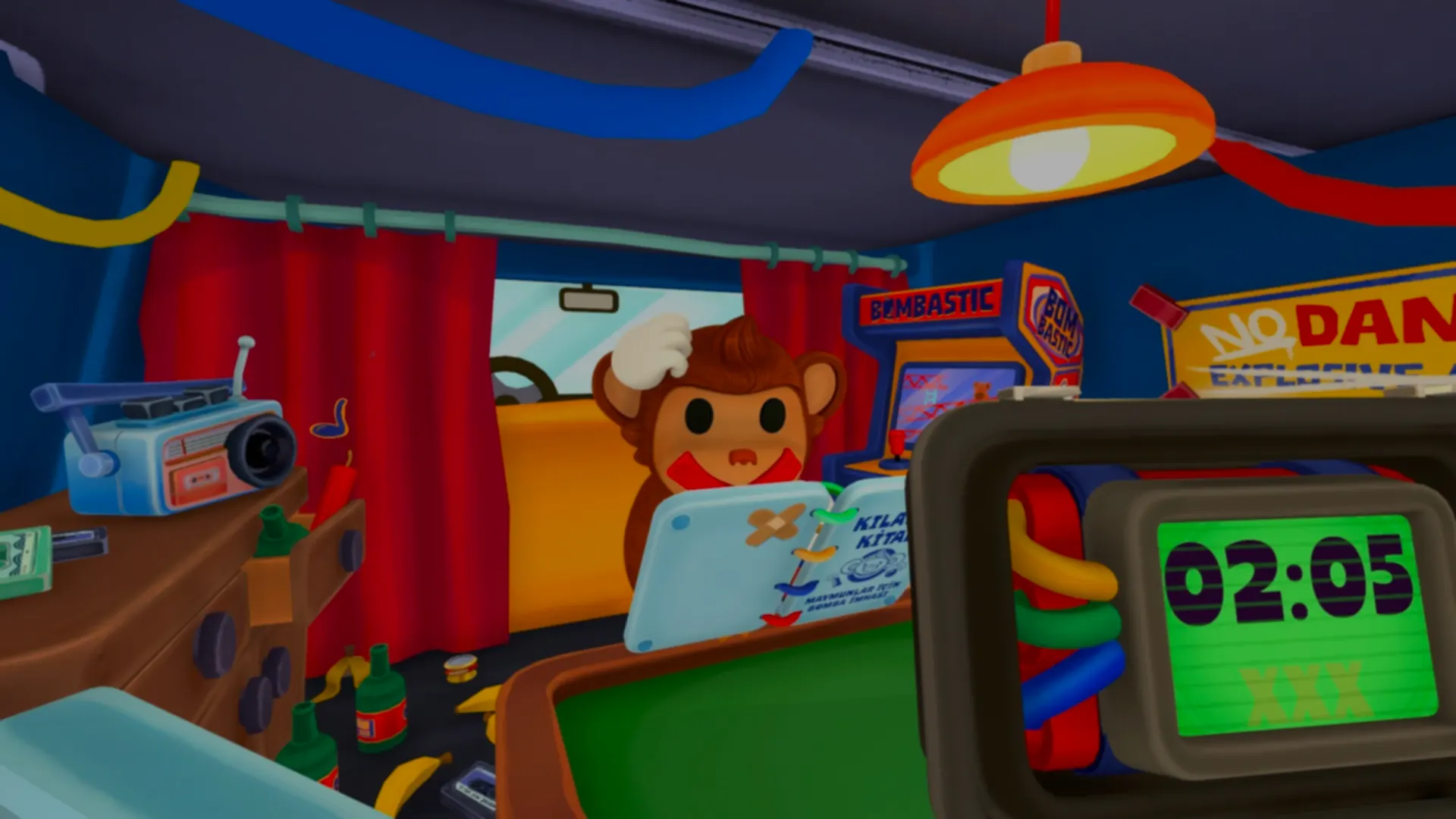
BOMBANANA! Beginner Guide: Roles, Modules and 30 Campaign Levels
A practical first-session guide to the three roles, manual handoffs, core modules and the 30-level Campaign progression in BOMBANANA!.

The first BOMBANANA! failure is usually a communication failure, not a difficult button. Three players each hold part of the answer: Blind Monkey touches and operates, Deaf Monkey sees the bomb and speaks, and Mute Monkey reads the manual. Keep that division clear before the countdown starts.
Assign the three roles
Blind Monkey: the final operator
Blind can touch modules and perform cuts, presses and switches, but should not rely on colors, screen text or spoken information from teammates. Blind should wait for one complete instruction and never guess when the location or order is unclear.
Deaf Monkey: the information relay
Deaf can see the bomb and speak, but cannot hear teammates. Report the module name, position and complete current state, not just “blue” or “three”. Watch both the bomb and Mute’s confirmation.
Mute Monkey: the rule checker
Mute can read the manual and determine the action, but cannot explain it by voice. Use an agreed gesture or signal to give Deaf one clear conclusion. Do not mix several gestures while still searching the manual.
These roles do not replace one another. The challenge is moving the right information through the chain, not letting one player solve everything.
Prepare before the timer
- Fix left and right from Blind’s view of the bomb.
- Agree on signals for “wait”, “safe to act” and “correction”.
- Deaf names the module and location; Mute opens the matching manual page; Blind finds the panel without touching it.
- Perform one action at a time and require a concrete command such as “top-right panel, cut the third red wire”.
Use one handoff loop for every module
Use this callout order:
Module → position → current state → manual result → Deaf repeats → Blind acts → result
For wires, for example, Deaf reports the panel, wire count, left-to-right colors and indicator. Mute checks the table, signals the answer, Deaf repeats the exact wire, and Blind cuts once. Blind then reports whether the module cleared.
This order prevents a correct answer being applied to the wrong panel. Repeating the final action also catches a gesture or perspective error before it becomes an explosion.
Early module habits
Wires
Always report count, fixed reading order, every color and indicator color. Wires are hard to undo, so consistent numbering is more valuable than saving a few seconds.
Direction or color slider
Confirm whose left and right are being used. Report lights and any number or tactile detail Blind can read. Calibrate the viewpoint on the first bomb and keep it unchanged.
Calculator or number module
Report the expression, indicator and panel location, not only the final number. Blind enters one digit at a time and reports feedback because the state can change after an input.
Switches
Read the indicator and every switch first. Mute identifies the target state; Blind moves one switch, reports the new state, and waits for the next instruction. Treat Enter as a separate confirmation.
Learn from an explosion
Classify the failure: a rule error means Mute used the wrong manual row; a relay error means location, order or direction changed in the callout; an execution error means Blind touched the wrong control; an attention error means Chaos interrupted an otherwise correct process. Repeat the relevant module when the same error returns. Rotate roles every few runs so the team can identify the real bottleneck.
Campaign: 30 levels in useful stages
The Steam Launch Features announcement confirms 30 handcrafted Campaign levels, plus Endless and Custom modes. Treat each stage as a communication lesson rather than an answer-key race.
| Stage | Levels | Main additions | Passing focus |
|---|---|---|---|
| Foundation | 1–3 | Cable and Color Slider | Fixed order, location and one action |
| Early pressure | 4–7 | Direction, Calculator, Random Easy, Slider/Pressure | Keep the same callout under random combinations |
| Mid game | 8–15 | Symbol, Piano, Soundboard, Random Medium, Alarm | Bind symbols, notes and numbers to the right panel |
| High pressure | 16–20 | Switch, Maze and more random modules | Save full states; confirm start and target before acting |
| Memory | 21–24 | Morse, Monkey-Says and interruptions | Record order and resume after a pause |
| Endgame | 25–30 | Random Hard and multiple Chaos effects | Separate missing knowledge from distraction |
Levels 1–7 teach stable basic calls. Levels 8–15 add symbols, piano and sound sequences, so use short team names and written order. Levels 16–20 require complete switch states and a confirmed Maze start and target. Levels 21–24 add sequence memory; label every note with module position and order. Levels 25–30 combine Random Hard with Alarm, Pressure and Slider effects, so practice pausing, repeating and recovering.
Replay or move on?
Replay when the same module and communication error repeats, or when a “win” cannot be explained. Continue after one clear misclick if the process was understood. Three failures with different causes may simply mean the level is adding pressure; use Custom for a single troublesome module.
Sources and limits
The three-player roles and platform facts come from the Steam store. Module handoff advice is based on collected community material; exact tables must be checked against the current in-game manual.
Related Articles
Puzzle Modules
BOMBANANA! Puzzle Modules Reference
How to identify modules, hand information between roles, use the switch workflow, and judge evidence for Level 8, Maze, Piano, Symbol and Morse searches.
Release & Platforms
BOMBANANA! Release Date and Platforms
The verified release date, Steam Demo, price snapshot, Windows and macOS support, and the current PS5, Xbox and Switch status.